
Autauga County Projected Release Date
A projected release date is a planned or computed date. It is not the same thing as the moment a person walks out of custody. Alabama Department of Corrections materials use the phrase "Minimum Release Date" for the earliest scheduled date an inmate can be released to probation or end of sentence. That field is the closest official ADOC match for a projected release date. ADOC also defines "Parole Consideration Date" as a tentative date set by the Parole Board, which is a different event.
For Autauga County release-date work, the first split is local jail versus state prison. A person in Autauga County Metro Jail on a pending case may be released by bond, dismissal, transfer, court order, or time served, but no fixed projected date may exist before sentencing. A person sentenced to ADOC from Autauga County has a state sentence calculation. That calculation can include jail credit from the Autauga Circuit Clerk, correctional incentive time, sentence type, and later changes sent by the court.
ADOC's official inmate search also has a major limit. It says the database only contains currently incarcerated inmates and that historical data is not available online. If an Autauga-sentenced person is no longer found in the ADOC current search, that result alone does not prove release. It may reflect release, a name mismatch, Youthful Offender Act exclusion, transfer, or another display limit. Formal confirmation may require ADOC records, Alabama VNS, parole records, the Autauga court file, or the proper jail records custodian.
Find Autauga County Projected Release
The practical search path should match the sentence. For a sentenced ADOC prisoner, use the ADOC inmate search only while the person is in current ADOC custody. ADOC gives the AIS number priority, so an exact AIS search overrides name fields. First and last names can be used separately or together, and name searches are open-ended, but results are capped. The search excludes Youthful Offender Act inmates.
For a local Autauga County jail sentence, the public sources did not publish a local good-time chart, weekend-release practice, or online projected-release calculator. Ask Autauga County Metro Jail or the sheriff records path how the local release date was calculated. If the sentence, jail credit, or disposition is the disputed piece, use the Autauga County court docket and the Circuit Clerk criminal division contacts. ADOC itself says jail-credit questions go back to the sentencing county's circuit clerk.
- Decide whether the person is held pretrial, serving a local jail sentence, or serving an ADOC state sentence from Autauga County.
- For current ADOC custody, search by AIS number when known; otherwise use first and last name carefully.
- Read ADOC fields such as Minimum Release Date, Jail Credit, Good Time Received, Good Time Revoked, Time Served, Total Term, and sentence type.
- For an Autauga jail sentence, call Metro Jail records or the sheriff's office and ask what record controls the release-date calculation.
- For jail-credit or sentence-paperwork issues, contact the Autauga Circuit Clerk and review the court docket.
- Use VINELink inmate search or Alabama VNS for eligible ADOC custody-change alerts, then confirm with the originating agency.
For a named released person rather than a future date, the broader release-record route belongs on Autauga County released inmates. That route separates a current jail roster, a jail release record, a court disposition, ADOC custody, parole status, federal custody, and immigration custody. A projected-release query is narrower: it asks which record currently controls the planned date.
ADOC Release Date Fields
ADOC definitions supply the most useful field labels for an Autauga County projected release date tied to a state prison sentence. Minimum Release Date is the main date field. Jail Credit reflects time spent in county jail before sentencing. Good Time Received and Good Time Revoked explain incentive time earned and lost. Time Served includes jail credit. Total Term is the sentence length. Type identifies whether sentences are consecutive or concurrent.
| ADOC term | Release-date value |
|---|---|
| Minimum Release Date | Earliest scheduled release to probation or end of sentence, subject to change. |
| Jail Credit | Autauga County jail time credited before sentencing, prepared by the sentencing county's circuit clerk. |
| Good Time Received | Correctional incentive time that can move a date earlier when the person is eligible. |
| Good Time Revoked | Earned time removed because of discipline or other qualifying conduct. |
| Sentence Type | Consecutive terms combine in sequence; concurrent terms run together with the longer term controlling. |
| Parole Consideration Date | A tentative Board consideration date, not the same as the minimum release date. |
Those fields can be useful even when the person was not released from an Autauga facility. The sentence may have started with an Autauga County case, moved to ADOC, and later returned to local supervision. The ADOC record, court record, and parole record must be read together when the release-date question turns on both time computation and supervision status.
Alabama Good-Time Rules
Alabama Code § 14-9-41 is the correctional incentive time statute. It governs good-time deductions and exclusions. The statute includes categories that cannot receive correctional incentive time, including Class A felony convictions, sentences over 15 years, life or death sentences, certain child sex offenses, and other listed categories. It also allows forfeiture for rule or law violations and bars further incentive time after serious prison violations listed in the statute.
The same statute explains who administers the rule by custody type. ADOC administers it for state penal institutions. A sheriff administers it for prisoners in a county jail. A chief of police administers it for municipal jail prisoners. That matters in Autauga County because the Metro Jail can hold city and county inmates, and the research did not find an Autauga-specific public jail good-time policy. Ask the jail or records custodian which local rule and record control a local sentence release.
The matched source image below comes from the official capture of Alabama Code § 14-9-41, the statute used for correctional incentive time.
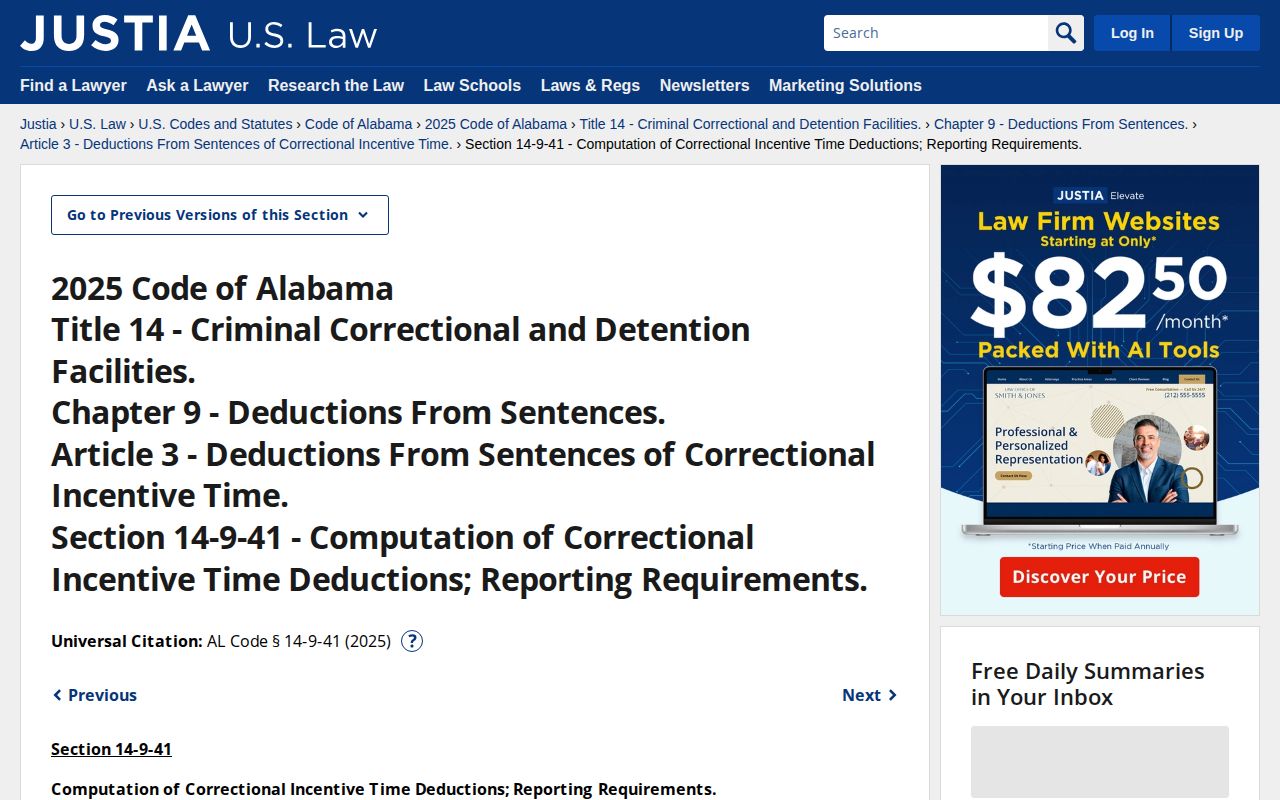
The statute explains why a projected date can move, but the actual date still depends on the person's custody record, sentence, jail credit, and eligibility.
Autauga County Parole Timing
Parole timing is related to release timing, but it is not the same. Alabama Code § 15-22-28 governs parole investigation and consideration timing. The statute ties parole consideration to sentence length, offense category, minimum release date, and Board scheduling. It also contains an 85-percent or 15-year framework for certain listed Class A felony categories. That should not be turned into a blanket claim that every Alabama inmate serves 85 percent.
For an Autauga-sentenced ADOC inmate, check parole as a separate status. A Parole Consideration Date can show when the Board may consider release to parole. A Board grant can show a decision. Neither one alone proves the person has physically left custody. Detainers, conditions, paperwork, transport, or a new order can still affect the actual release date. Use Autauga County probation and parole when the key question is supervision after release rather than the computed sentence date.
Note: Minimum Release Date, Parole Consideration Date, and actual release date answer three different record questions.
Autauga County Jail Credit
Angle O from the Autauga research is the local computation issue: ADOC says jail credit is prepared by the sentencing county's circuit clerk. For an Autauga-sentenced state inmate, missing or corrected jail credit can change the Minimum Release Date. The court clerk is therefore not just a side contact. It can be the correction route when the projected release date seems too late or does not match the known time spent in Autauga County Metro Jail.
The Autauga court page lists courthouse contact information and links to docket resources. The Circuit Clerk's page lists criminal division contacts, including Circuit Criminal and District Criminal / Traffic. Use those contacts to locate the sentencing record, disposition, jail-credit paperwork, or corrected order. If ADOC has not received the corrected paperwork, the ADOC field may not update until the sentencing record is transmitted and processed.
The matched source image below comes from the Autauga Circuit Clerk contact page used for jail-credit and sentencing-record follow-up.
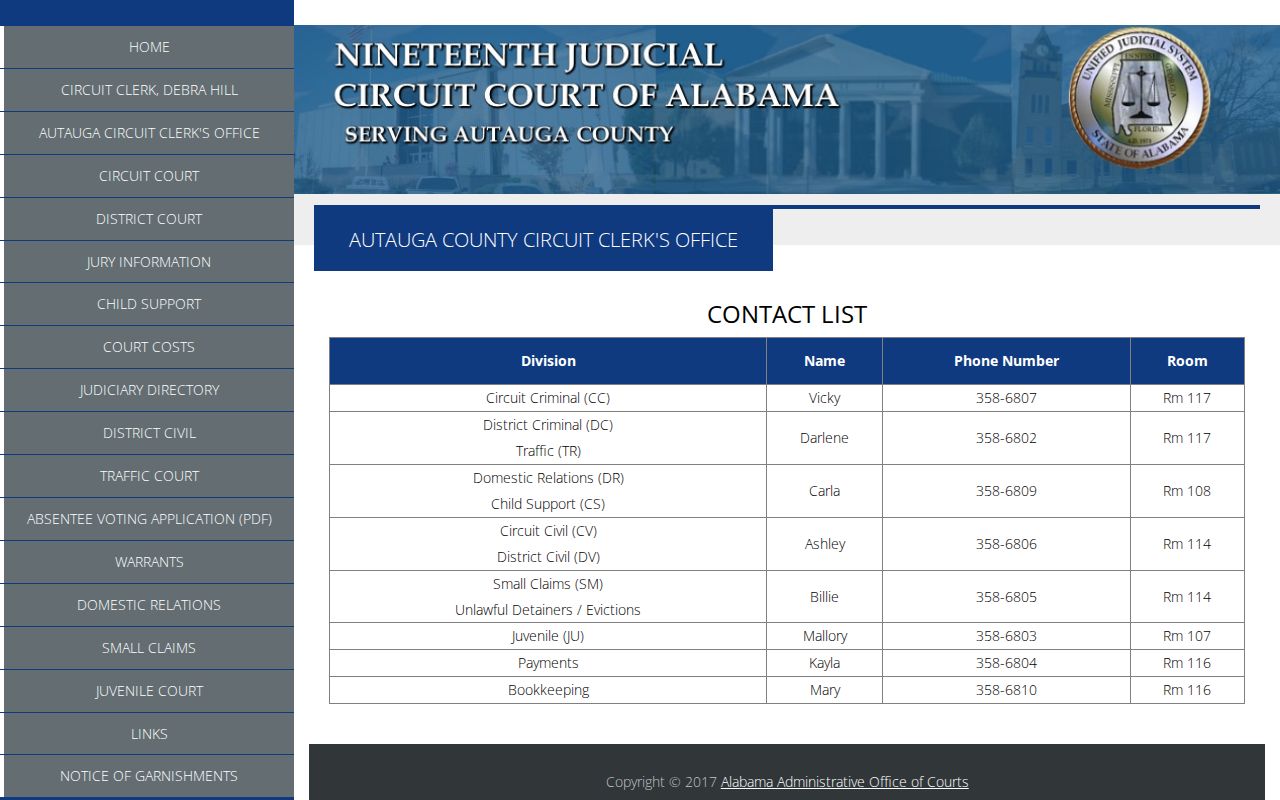
Use the clerk contact when the release-date issue depends on local jail credit, corrected sentencing papers, or the Autauga docket rather than an ADOC display question.
Why Autauga Release Dates Change
A projected release date is a live calculation. Alabama sources identify several reasons it can change. Some reasons start in the court file, such as a corrected sentence or jail-credit update. Others start inside the custodial agency, such as good-time earning, good-time revocation, discipline, or a recalculation of consecutive and concurrent terms. A detainer, warrant, new case, or revocation can also prevent a person from leaving custody on the expected date.
| Change factor | What to check |
|---|---|
| Court correction | Autauga Circuit Clerk, sentencing order, amended order, or docket entry. |
| Jail credit | Sentencing county paperwork and ADOC Jail Credit field. |
| Good time earned | ADOC or jail records and Alabama Code § 14-9-41 eligibility. |
| Good time revoked | Disciplinary records and ADOC Good Time Revoked field. |
| Sentence structure | Concurrent or consecutive term calculation. |
| Hold or detainer | Jail records, court records, BOP, ICE ODLS, or another agency record. |
| Parole action | Board hearing schedule, results, minutes, and field-office confirmation. |
Autauga County's 2024-2026 Metro Jail disruption adds another practical caution. Local reporting described inmates being housed in other jails during repairs and returning later. If a person had an Autauga case but was physically held elsewhere, ask Autauga records whether the release date, transfer date, or receiving-jail record controls the event being researched.
Confirm Autauga Release Timing
Confirmation should use the agency that controls the date. For current ADOC custody, use ADOC record fields, Alabama VNS if eligible, and parole records where a Board event exists. For local jail custody, use Autauga County Metro Jail records, the sheriff's office, and the court record. For federal or immigration custody, use BOP or ICE channels instead of a county projected-release path.
Alabama VNS is useful but limited. The official Alabama VNS page says it is for offenders convicted in Alabama and sentenced to ADOC custody. It also directs pretrial or county-case inquiries to the sheriff in the county where the case occurred. That means a VNS alert can help with an ADOC-sentenced release, but an Autauga County jail-only release still needs sheriff, jail, or court confirmation.
Alabama public-record law supports formal requests when online channels do not answer the release-date question. Alabama Code § 36-12-40 and § 36-12-41 are the general inspection and copy provisions. Restrictions can still apply for sealed, expunged, juvenile, Youthful Offender Act, safety, medical, or other protected records.